
The electrification of heavy goods vehicles is one of the most complex challenges in transport decarbonisation. Unlike passenger cars, freight vehicles travel long distances, operate on variable routes, and require high-power charging infrastructure that does not yet exist at scale.
For policymakers and infrastructure investors, the core planning question is deceptively simple:
Where should electric HGV charging infrastructure be built first?
In Scotland, this question is being addressed through the Heavy Goods Vehicle Market Readiness Fund, a Transport Scotland programme designed to accelerate the transition to zero-emission freight by supporting industry collaboration and evidence-based infrastructure planning.
As part of this initiative, the Telford Consortium, led by Aegis Energy, is analysing real-world HGV movement patterns to identify where charging infrastructure would be most effective, commercially viable, and aligned with freight operations.
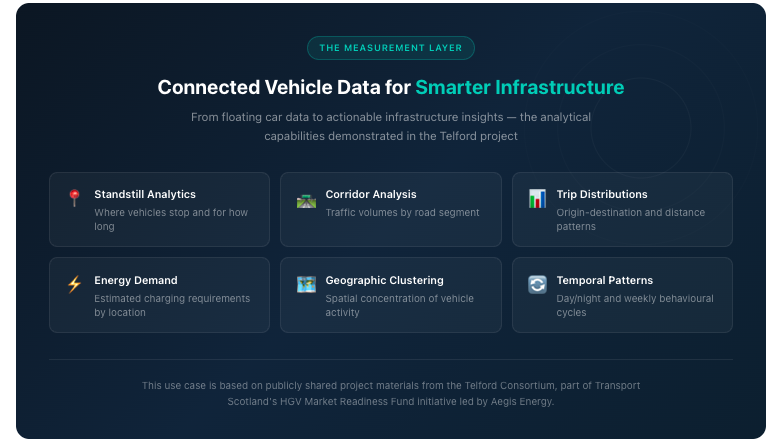
Within the project, Mobito provided anonymised vehicle probe data and standstill analytics, enabling the consortium to analyse large-scale HGV movement patterns across Scotland's road network. This floating car data is combined with fleet telematics from participating operators to create a comprehensive picture of how freight vehicles travel, stop, and operate in practice.
The project offers a powerful example of how vehicle-derived data can serve as a measurement layer for transport infrastructure planning, helping policymakers and infrastructure developers move from assumptions to evidence when designing the next generation of freight charging networks.
The Planning Challenge: Infrastructure Without Operational Evidence
Freight electrification faces a classic investment deadlock.
Fleet operators are hesitant to transition to electric trucks without reliable en-route charging. Infrastructure developers cannot justify multi-million-pound charging hubs without confidence that sufficient demand will exist. Public authorities must allocate limited funding without clear evidence of where infrastructure will have the greatest impact.
Traditional planning methods struggle to resolve this uncertainty. Traffic counters, surveys, and static transport models cannot capture the dynamic operational behaviour of freight fleets — including where vehicles actually stop, how long they remain stationary, and which corridors concentrate the majority of long-distance traffic.
What infrastructure planners require instead is continuous, large-scale behavioural data describing real vehicle movement across the network.
This is where floating car data provides a fundamentally different perspective.
The Anonymised Vehicle Data Approach: Probe Data and Standstill Analytics
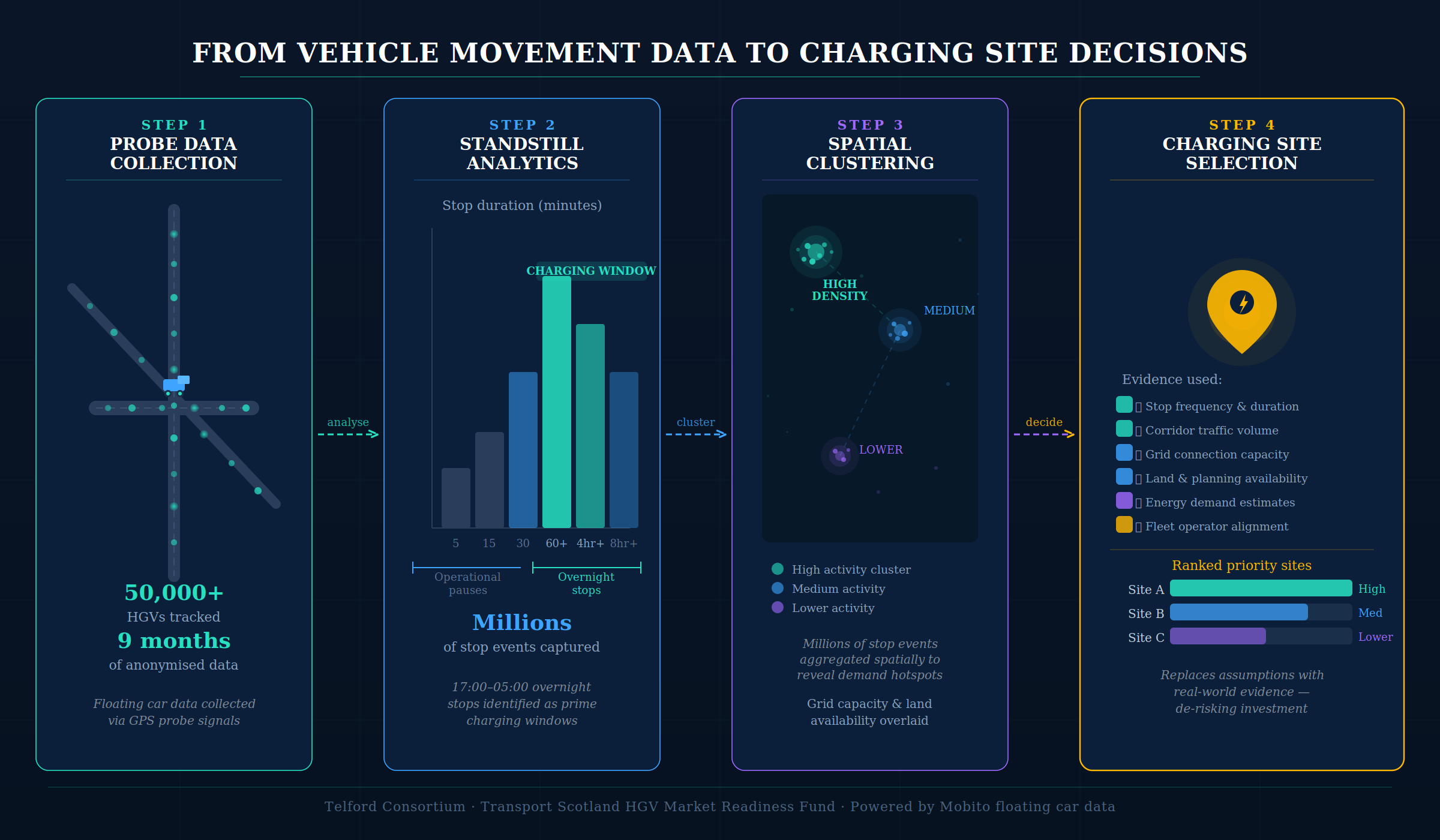
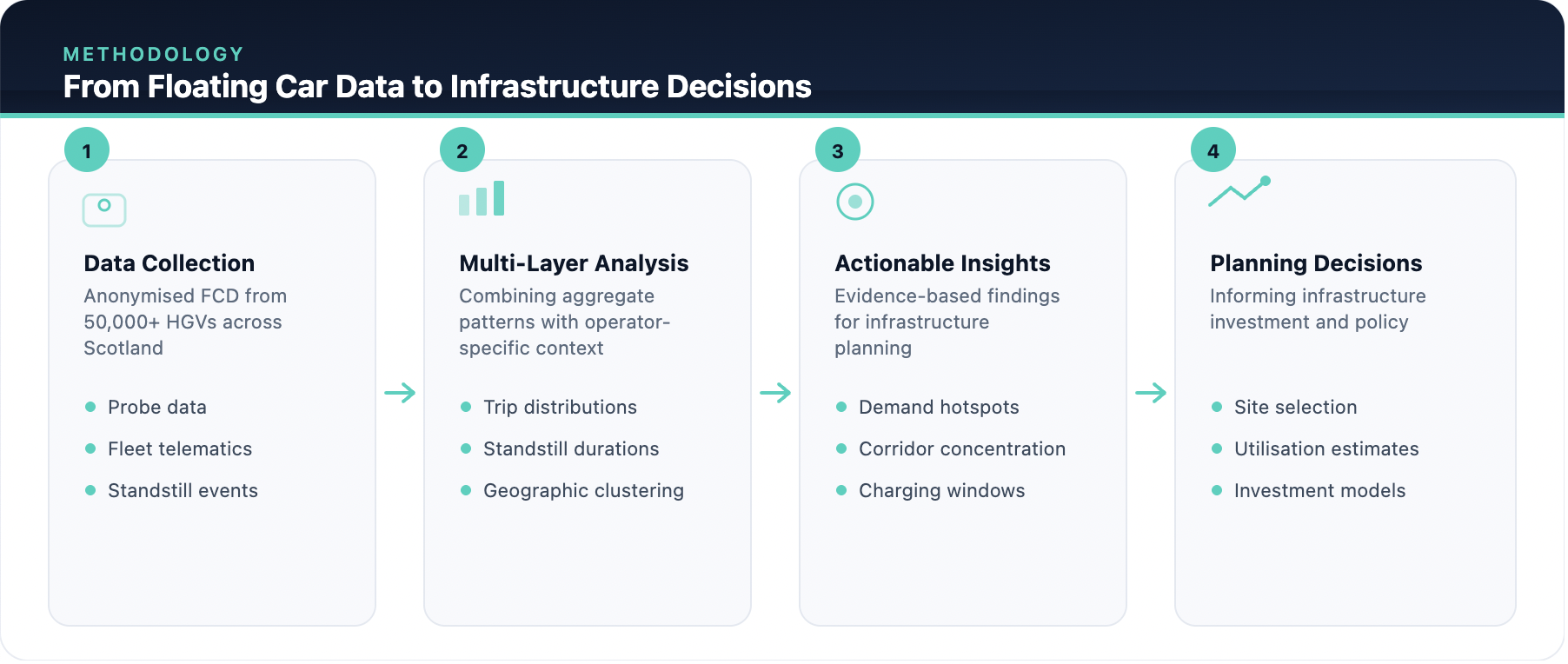
The Telford project analysed anonymised probe data from more than 50,000 heavy goods vehicles operating across Scotland. The dataset was processed through strict anonymisation and aggregation procedures, ensuring that individual drivers cannot be identified.
The dataset captured standstill events — moments when vehicles stop and remain stationary — recording their location, duration, and time of day.
Collected over one week per month across nine months, the dataset generated millions of individual stopping events, providing a detailed behavioural picture of freight activity across the national road network.
This floating car data was analysed alongside direct fleet telematics provided by consortium partners. The combination enabled a layered analytical approach:
- Probe data provided network-wide coverage and statistical scale.
- Fleet telematics provided operational context such as duty cycles, trip purposes, and depot patterns.
Together, the datasets enabled planners to analyse several critical dimensions of freight movement:
Trip length distribution.
Origin-destination analysis revealed whether
fleets operate primarily in local delivery cycles or long-haul corridor movements.
Standstill duration analysis.
Short operational pauses — such as loading
or shunting — were distinguished from extended stops where meaningful charging could
occur. Overnight stops between approximately 17:00 and 05:00 proved particularly
important, offering substantial windows for energy transfer.
Geographic clustering of stopping activity.
Standstill events were
aggregated spatially to identify locations where HGV activity concentrates. These
locations were then evaluated alongside electricity grid capacity and land availability.
Corridor traffic flow analysis.
Probe data along trunk road segments
enabled the team to quantify HGV volumes and estimate potential charger utilisation
at candidate hub locations.
What the Data Revealed
The analysis illustrates how large-scale vehicle probe data and standstill analytics can uncover patterns in freight operations that are difficult to observe through traditional transport planning methods. By examining trip structures, stopping behaviour, and corridor-level flows, the project generated several categories of insight relevant to infrastructure planning.
Corridor movements drive a large share of freight energy demand
Analysis of trip length distributions revealed clear differences between local delivery activity and longer-distance freight movements along national trunk corridors. While shorter depot-based trips are frequent, long-haul journeys account for a disproportionate share of total vehicle kilometres travelled and therefore overall energy demand.
Understanding where these corridor movements occur is critical for charging infrastructure strategy. The analysis demonstrates that public, en-route charging infrastructure will play an important role alongside depot charging, particularly for freight operations that extend beyond regional logistics networks.
Freight traffic concentrates along key national corridors
Aggregated probe data made it possible to identify where heavy goods vehicle traffic naturally concentrates across the national road network. Rather than being evenly distributed, long-distance freight movements tend to cluster along a limited number of strategic corridors connecting major economic centres and ports.
For infrastructure planners, this type of analysis highlights how a relatively small number of well-positioned charging hubs could potentially serve a significant share of corridor traffic, improving utilisation rates and strengthening the business case for high-capacity charging sites.
Operational patterns vary significantly across fleet types
Combining probe data with fleet telematics provided insights into how different categories of freight operators use the road network. Some fleets operate predominantly within regional delivery cycles with regular return-to-base patterns, while others run extended inter-regional routes with different stopping behaviours and dwell times.
This diversity in operational profiles highlights that charging infrastructure strategies must accommodate multiple duty cycles, rather than assuming a single operational model for electric freight.
Local fleet activity and long-haul corridor demand follow different spatial patterns
Standstill analysis also revealed that locations with high levels of local freight activity do not always align with the corridors used by long-distance freight flows. Sites suitable for supporting depot-based operations may therefore serve a different segment of the freight market than infrastructure designed for en-route charging.
Recognising these distinctions allows planners to better differentiate between local charging needs and corridor-based infrastructure, helping ensure that investments support the full range of freight operations across the network.
This type of behavioural insight demonstrates how vehicle-derived data can provide a far more detailed picture of freight movement than traditional planning tools, enabling infrastructure strategies that reflect how transport systems actually operate in practice.
From Data to Investment Strategy
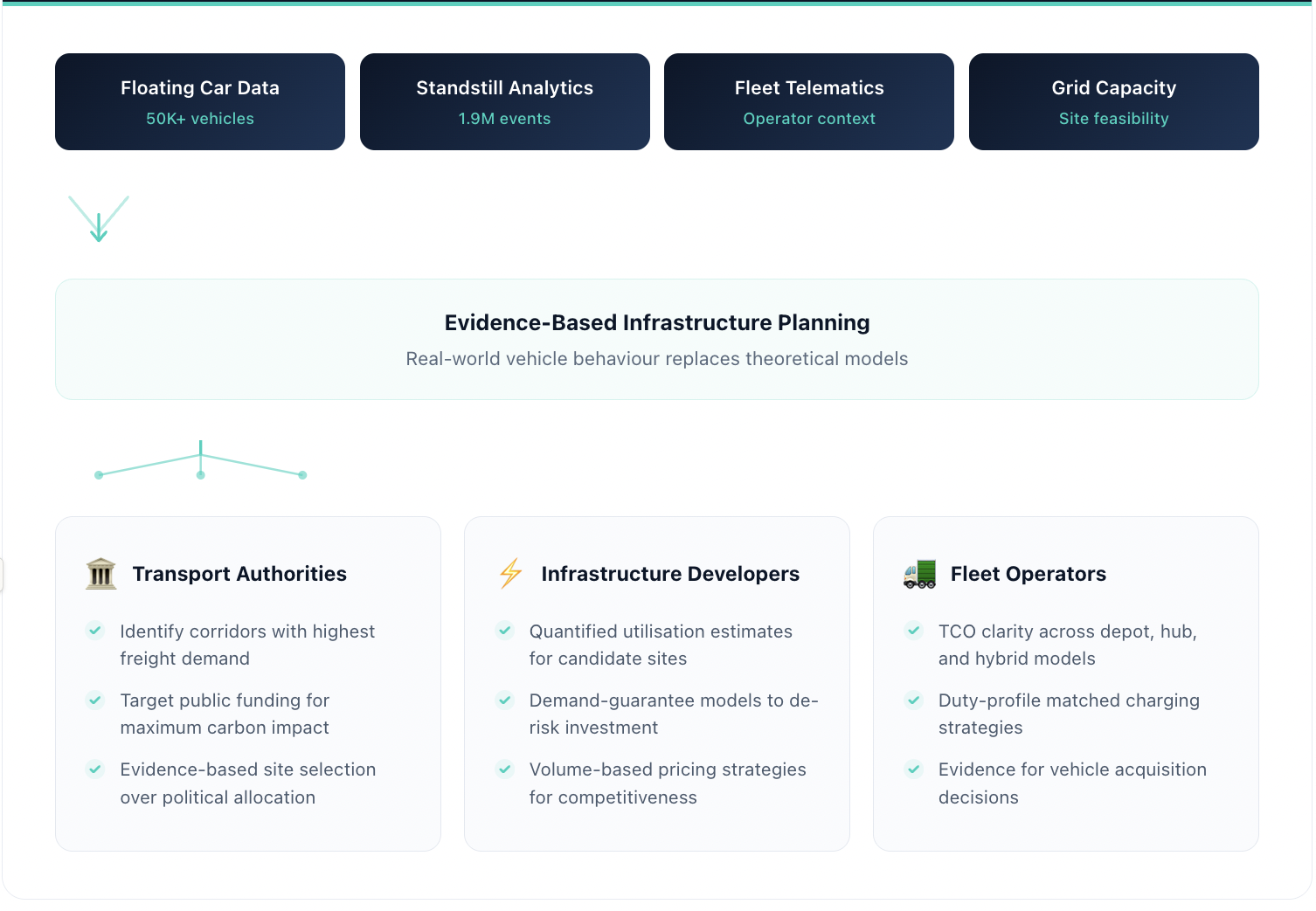
For transport authorities and infrastructure developers, these insights transform infrastructure planning from theoretical modelling to evidence-based decision-making.
Rather than relying on projected traffic models, planners can identify:
- corridors with the highest freight demand
- locations where vehicles naturally stop
- potential charger utilisation rates
- realistic energy demand volumes
Using this evidence, the Telford Consortium proposed a demand-guarantee mechanism in which public and private partners jointly underwrite energy volume commitments. This approach helps de-risk infrastructure investment while accelerating the deployment of high-capacity charging hubs.
For fleet operators, the analysis also provides greater clarity around total cost of ownership under electrification, helping determine whether depot charging, hub charging, or hybrid approaches best suit their operations.
A Replicable Methodology for Freight Decarbonisation
Although the Telford project focuses on Scotland, the methodology is broadly transferable.
Any region with access to anonymised floating car data and structured standstill analytics can apply a similar framework to:
- identify optimal charging locations
- estimate corridor-level energy demand
- assess infrastructure utilisation
- design investment mechanisms that bridge the gap between policy ambition and commercial viability
As freight electrification accelerates across Europe — from zero-emission logistics zones in the Netherlands to electrified freight corridors in Germany — the ability to ground infrastructure strategy in real-world vehicle movement data will become increasingly important.
Vehicle Data as a Measurement Layer for Transport Infrastructure
The transition to zero-emission freight will not be driven by technology alone. It requires a deep understanding of how freight systems actually operate: where vehicles travel, where they pause, and how those patterns translate into infrastructure demand.
Connected vehicle data is emerging as a powerful measurement infrastructure for physical transport networks, linking mobility patterns with energy planning, infrastructure investment, and policy design.
The Telford project demonstrates that when infrastructure planning begins with real-world vehicle behaviour, the path toward freight decarbonisation becomes significantly clearer.